HCDE 351 | A5: Video Prototype: Pre-sleep Phone Use Control App
This process log documents the video prototype of a pre-sleep phone use control app which is a better version of social media where users may not get addicted to it then affect their sleep quality thus influenced their schedule of next day.
 Antares Yuan
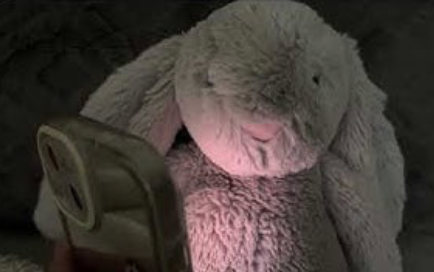
Product Overview:
This process log documents the video prototype of a pre-sleep phone use control app which is a better version of social media where users may not get addicted to it then affect their sleep quality thus influenced their schedule of next day. The goal of this video prototype is to test out functionality and usability, where we can set up a use case with a limited cost and fast pace of iteration. In this project, I practiced my skills of making a video prototype by brainstorm the storyboard, set up the video shooting checklist, and then slicing frame into multiple cameras and assemble them into a whole storytelling video.
In this log, I will describe how I brainstormed based on my design scenario setting, made iteration on my story itself, gathered feedback from users and peers, and identified parts that should be improved. I also document the reasoning behind key decisions and how these choices work better in supporting my story.
Ideation:
The goal of this design is to make a video prototype that can be used in testing a use case and user scenario, helping the designer making design decisions of how to iteration to the next step. In this section, I will explain how I iterate throughout these different ideas to better align with my design goal.
The topic I pick is something related to "sleep". I started with thinking of my own pain point related to sleep. I came up with these in my head.
Painpoint:
- I wanna go to bed earlier, but every time when I was lying in my bed, I found out that I got lost in the infinity scrolling in the social media content.
- Malignant pre-sleep phone use made me hardly to focus on the task on the second day, or feel sleepy during the period that required my attention.
- In the long term, I felt that this had behavior made me hard to focus, and impact my mental health dramatically.
Before finding some ideas by gathering inspiration from some academia paper, and thinking about how I can also stress the pain point using my design as a solution and tell the story, I first came up with the scenario setting for this story.
Scenario Setting:
Persona: "A" is a 25-year-old young adult who just step into the society from university, working for an AI start-up as a software developer.The scenario: "A" usually comes back to home form work on 6 pm in the evening, then he always plays some game and read some news online before he go to bed. After he lies on his bed, he scrolls on his phone to see the stories shared by his friends, swipes his phone to see twitter and reddit posts, watches some Tiktok short reals.
After having sense of the scenario my video and product I will be designing. I started my storyboards.
Storyboard:
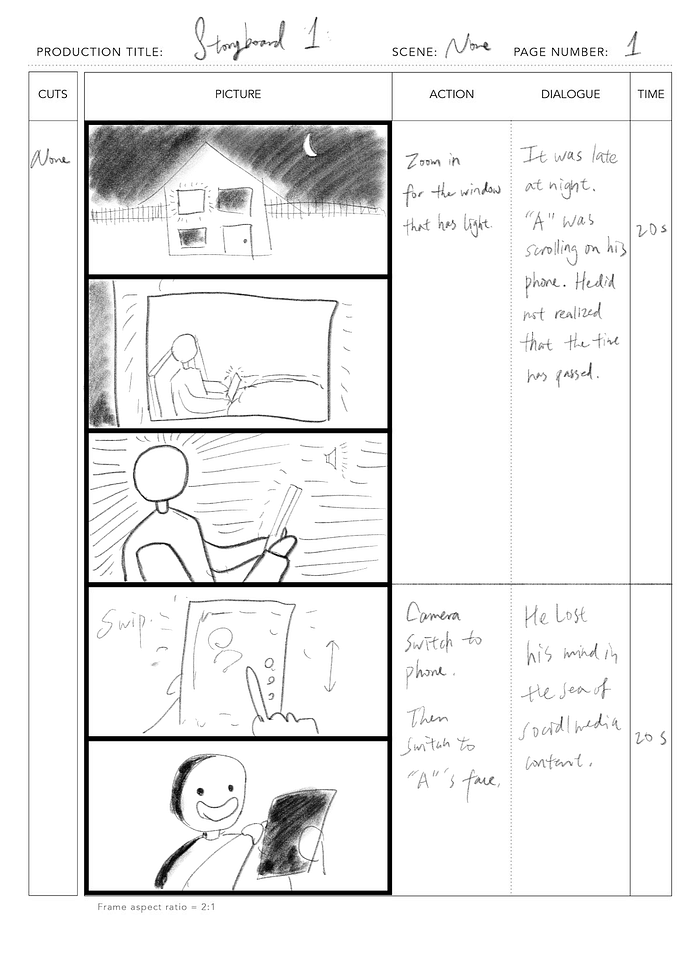
Storyboard Page 1
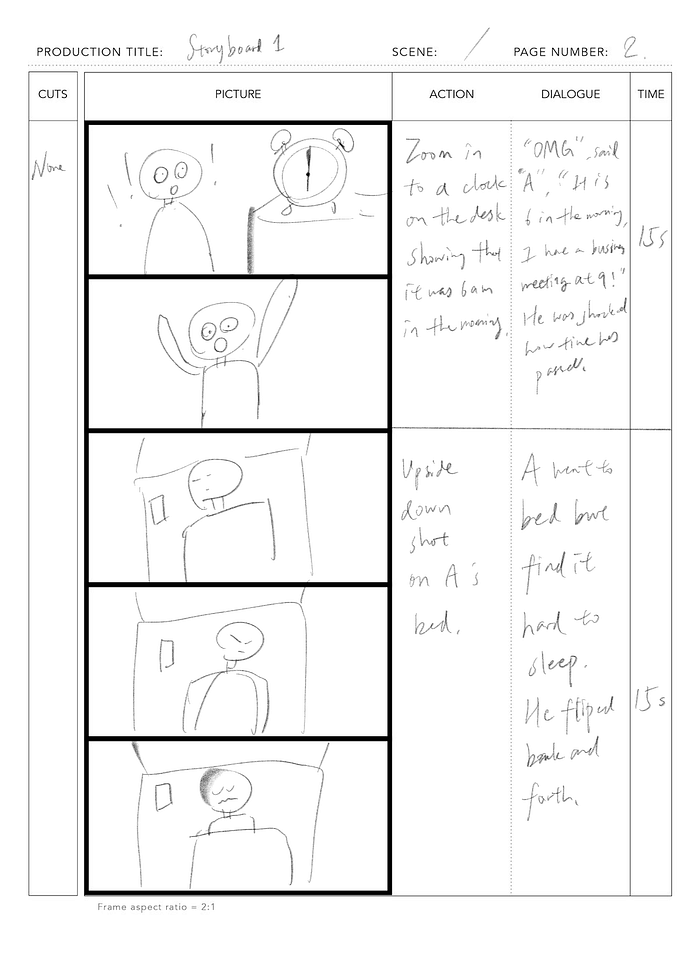
Storyboard Page 2
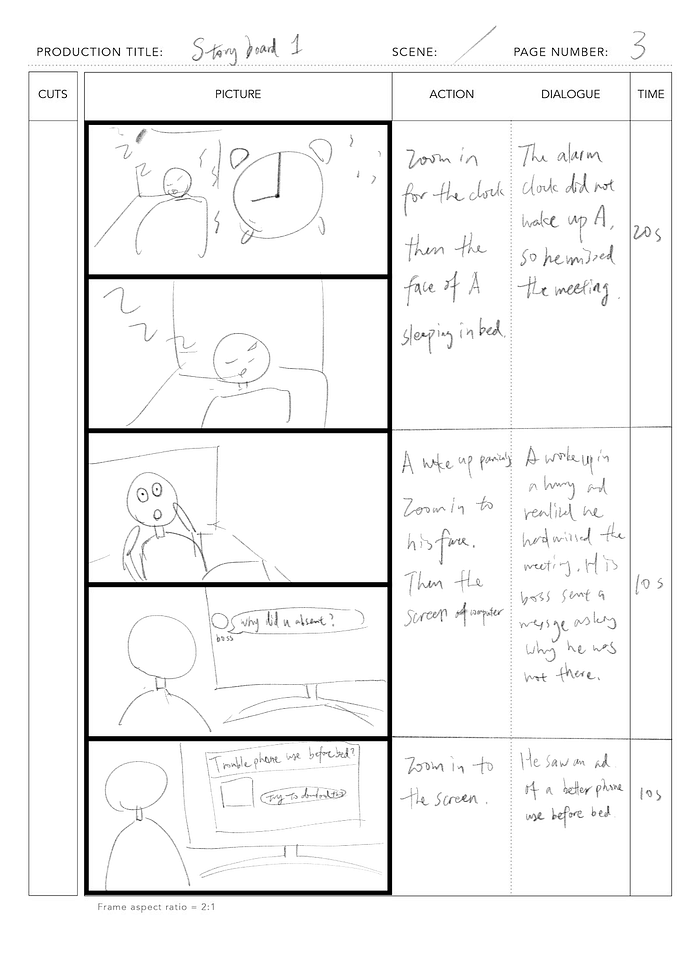
Storyboard Page 3
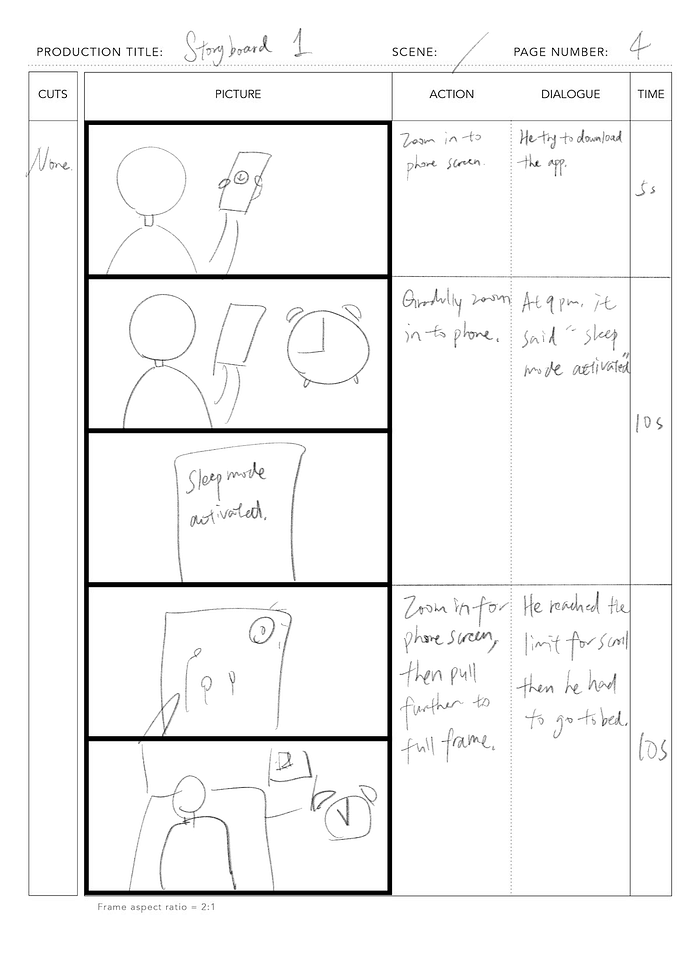
Storyboard Page 4
In this section, based on my scenario setting, I began to think about what kind of story I should tell. I chose to set the beginning of the story at midnight, which is exactly the time when my protagonist “A” is preparing to go to bed. Initially, I want to show a long shot, showcasing the exterior of “A’s” house, with all the other rooms dark, only “A’s” room is brightly lit. Then, the camera slowly zooms in on his window, revealing him scrolling through his phone. Through a series of close-ups, the camera focuses on the phone screen, showing him deeply engrossed in social media, unable to pull himself away. (I also included a shot that shows him addicted to scrolling, with the flickering light reflecting off the phone onto his face). The conflict in the story arises from the protagonist missing an important meeting the next day due to staying up too late watching videos, leading to punishment from his leader and being exhausted both physically and mentally, deciding to start making changes. So, I set up a turning point in the story where he sees an advertisement on a website about a social media app with a sleep mode. I then let the story progress to the protagonist downloading and starting to use this app. The automatically activated sleep mode adds an extra layer of supervision to his phone use before bed, and after his swipe limit is exhausted, he chooses to go to sleep early, thus achieving better sleep.
Prototype:
In the sections above, I explained how I made sure I know what scenario I am designing for, then I explored ideas and then push to the storyboard I should go for by following the design goal. In this section, I will briefly talk about the process of making my final video prototype by iterate on the story in the storyboard.
Final video prototype
In fact, it can be seen that the final video prototype I made has undergone significant changes from before, one of the main reasons being that I discovered the limitations of my own filming. My filming equipment is the iPhone 13 Pro, without a stabilizer/tripod/monopod, and I also found that I couldn’t do aerial filming (because I don’t have a drone to assist with shooting). So I made adjustments, turning the night scene into elements like desk lamps and clocks, which are easier to obtain and still have a decent effect, to express the late night. Also, to emphasize privacy (or perhaps I haven’t found a suitable model), I chose to use a doll to act out the story (but I personally feel that the effect is actually better than using a real person); also considering the feasibility, I changed the business meeting into a scene of someone dozing off at work. The intervention part remained mostly unchanged. This is my final video prototype, aligned with my design goal, and satisfy my design scenario.
Feedback:
In class, we had a group feedback discussion. This is the feedback I received:
What works well?
- Clear core problem: “I can’t fall asleep / I stay on my phone” is relatable and easy to understand.
- Strong visual hook: the rabbit falling asleep is memorable and already feels like a “main character” people can follow.
- Good instinct on structure: I already have a story arc (intro -> intervention -> outcome), which is exactly what these pitches want.
What could be better?
- Rabbit (the toy) meaning is unclear: right now it’s cute, but not legible. Viewers need to instantly know: rabbit = you? sleep drive? progress meter? pet companion?
- Needs “real interface” credibility: “show me the product.”
- Missing subtitle: my title slide (or early slide) should include a subtitle that states what it is in plain language.
- Background intro too long: I am spending time convincing them sleep matters; they already know.
- Mechanism needs to focus on “forcing me to sleep”: “you described context but not enforcement.”
Takeaways:
Feedback from both my peers and my TA reveal that my design did successfully align with my design goals and stress on the pain point as well as following my scenario. But there this design have some minor issue that may or may not impact it functionality. It could be better if I,
- clarified what the rabbit represents and how it functions within the system.
- focused more on the mechanism that enforces sleep rather than extended background context.
Reflection:
Through making this video prototype, I learned that video is not just for presenting an idea, but for quickly testing whether a story, mechanism, and interaction make sense. I chose the topic of pre-sleep phone use because it is a personal pain point, which helped me build a realistic scenario and evaluate the design more critically.
The main challenge was limited filming resources, which forced me to adapt the storyboard and simplify the narrative. This made me realize that feasibility constraints can actually help sharpen the core idea. Feedback also showed that while the rabbit was visually engaging, its meaning was unclear, and that I needed to show the actual interface earlier and focus more on how the system enforces behavior change.
If I were to redo this project, I would define the role of the rabbit more clearly and make the enforcement mechanism more explicit from the start.
Thanks for reading! : )
Technological Appendix:
AI usage:
- I used ChatGPT in correcting my grammar and typo;
- I used NotebookLM to help me organize user feedbacks;
- I discussed with ChatGPT of parts I should improve with the feedback I got.
- I discussed with ChatGPT how I can refine my reflection.
Writing reference:
- I used the overall structure of the blog from my last blog as a reference of this blog. Some of the words written by myself are the same (some transition sentences and words).
- Here is my reference blog: https://antaresyuan.site/blog/hcde-351-a2-soft-goods-prototype-shoulder-bag-design/
Inspirational reference:
Bartel, K., Scheeren, R., & Gradisar, M. (2019). Altering Adolescents’ Pre-Bedtime Phone Use to Achieve Better Sleep Health. Health Communication, 34(4), 456–462. https://doi.org/10.1080/10410236.2017.1422099
Vhaduri, S., & Poellabauer, C. (2018). Impact of different pre-sleep phone use patterns on sleep quality. Proceedings (International Conference on Wearable and Implantable Body Sensor Networks : Print), 94–97. https://doi.org/10.1109/BSN.2018.8329667